Sunday, August 15, 2010

Winter? Dull? Where?

It's a myth that winter is a tedious time in the garden.
OK, you aren't out sunning yourselves on the grass, eating tomatoes warm off the vine, or surrounded by fragrant rose petals, but it doesn't have to be a time of boredom and gloom.

First, if you have deciduous trees, you get to see the structure of your garden: the architecture of the treetops; the bark and buds and sky beyond.

Then there are the many flowers - some subtle, like hellebores, some party animals such as narcissus - that take the opportunity to shine when the sun's behind the clouds and you really need a spot of brightness.


If your garden's feeling a bit dull, take a walk around the neighbourhood and see what's in flower so you can plan for next year and the years ahead. This is what I found in bloom this morning on my walk.

In my garden:
White hardenbergia
Daffodils, Earlicheer jonquils, and miniature daffs
Hellebores (Soft pinks, greens and cream)
Grevilleas (red)
Wattle
Hyacinths (blue and pink)
Muscari (grape hyacinths in a deep blue)
Maleleuca
Correa (white, cream and pinky green)
Light mauve miniature (Algerian) iris
Euphorbia
Borage
That bright yellow daisy thing whose name I can never remember
Emu bushes (red and yellow)
Swan River pea.
I also had some lovely red beetroot and rainbow chard in the veggie patch, along with bright yellow flowers on the rapini (but only because I forgot to pick it). And cymbidium orchids in various stages of spiking or fading.


There are things that are more or less always in flower. Here, that includes:
Penstemons (red)
Rosemary
Westringia (purple is year-round, white not quite so)
Daisies of various sorts
Dark purple bearded iris

In other people's gardens I saw:
Purple hardenbergia
Violets galore (mine aren't out yet)
Kangaroo paws in various shades of red
Native hibiscus
Camellia (mostly in nasty pinks, but also some nice ones)
Early flowering cherries
Flowering quince
That horrible South African purple pea thing
And lots of magnolias only a week or so away from opening.

See? Virtually spring already.

Sunday, July 11, 2010

On yellow


We think of yellow as a summer colour, but in fact around here it's the colour of winter.
Lucky, that, because in the dead of winter we all need the hope (will spring really come again?) and splash of warmth that yellow brings.
Again, we think of many yellow flowers as emblems of spring - the wattle along the roadside, the daffodils in an old farm yard, sheets of jonquils in the orchard. But in fact they all tend to make an appearance in winter, just when we need them, along with yellow and creamy daisies and irises, grevilleas, wintersweet (though mine died over summer so it's more brown than yellow), correas and even my new favourite yellow emu bush.
So too the lemon tree hangs heavy with fruit just when you need the hot lemon and honey drinks to get you through a winter cold.
Isn't nature clever?

Tuesday, June 22, 2010

Sod

After several weeks' delay I finally turned the first sod in my new allotment in the community garden down by the river.
And what a joy it was.
Drive in the fork and gorgeous loamy stone-free soils simply lifts up and turns over. Just like it should. I nearly cried with relief.
Every spadeful I turn here in the bush backyard is a hard-fought battle with hard or sticky clay, splinters of shale, and crap from the house construction forty years ago.
In the new patch, however, it's well-loved soil in a raised bed, far from eucalyptus roots and safe from rabbits.
So I divided the rhubarb in my backyard and took three new crowns along to plant in the allotment, plus broadbeans and onions to sow. Needless to say, when I got there, I found that the clump of rhubarb already in the corner of the patch needs dividing as well. I think I'll have to start a rhubarb farm.
I'll leave much of the rest of the patch fallow for the winter until there's no danger of frost, and then plant some spuds. I don't know what's been planted there previously so it may need a rest.
It really feels like luxury to have so much room and so few soil hassles.
The community garden is very well set up, too, as I suppose they all are. It's a growing (pardon the pun) movement, but of course allotment growing is a traditional post-war past-time in Britain, where people have such small yards.
Our community garden has water tanks and a glasshouse (though it doesn't seem to be in use at present), a shed with a great range of communal tools, a gazebo and cubby house for a bit of relaxation, and even a barbecue for working bees.
If you have spare seeds, you add them to the seed exchange box and share them around - I tried out some different sorts of onions to mix with those I'd brought along. There are also collective herb and fruit plantings around about, and a gorgeous compost system which made me deeply jealous.
So if you have trouble growing food in your backyard, or would like the experience of communal growing, a community garden is a great option. They are dotted all over the place, but especially in the cities.

Other things to plant or sow during June include:
- Asparagus
- Garlic
- Silver beet or rainbow chard
- Cabbage
- Leeks
- Lettuce.
It's also time to prune roses, cut back perennials (be brave!) and move or plant any deciduous trees or shrubs such as bare-root fruit trees and roses - more roses.

Friday, June 11, 2010

Hiatus

No time for gardening for the last few weeks, let alone blogging about it.
Normal transmission resumes next week.

Saturday, May 8, 2010

On purple

Not long after we moved into our house, and well after a great deal of garden planning had taken place, I was shocked to learn that my partner hates purple flowers.
How is that possible?
I don't know, but then since I can't bear a great many pink flowers I guess I have to concede the point, especially given that irises, lavender, rosemary, violets and pansies are exempted from the ban. And some purples are really too harsh - metallic, somehow, like that nasty little hebe I pulled out this afternoon.
But it came to light after I had planted the indigenous climber Hardenbergia all along the driveway. (I didn't own up, but luckily the rabbits ate them all and destroyed the evidence.)
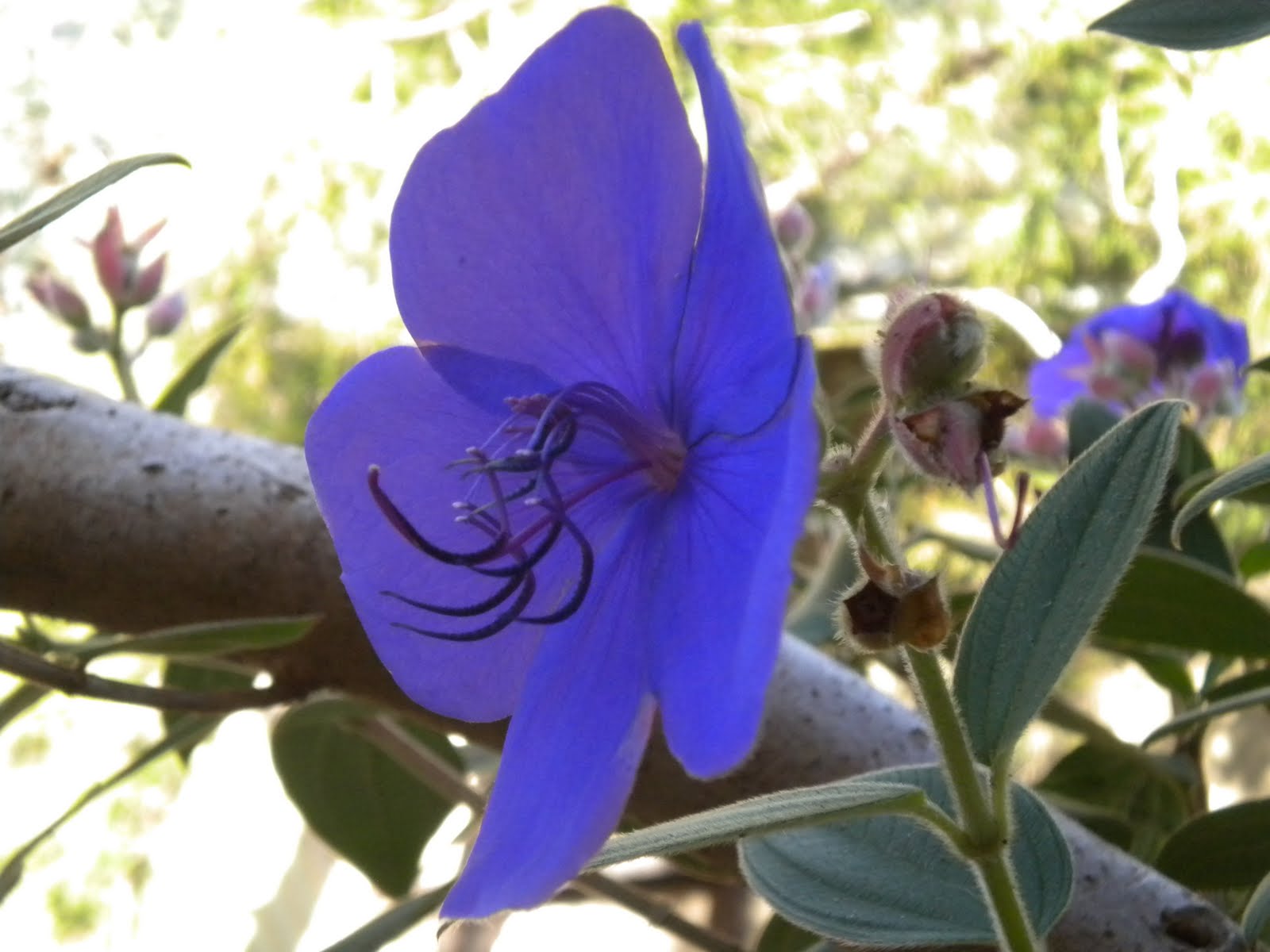
Rather more disturbing was the fact that all my life I have wanted a Tibouchina, and was thrilled to find not one but two here when we bought the house.
"They'll have to come out," I was told, in no uncertain terms.


Well, three years later they're still there, hanging on, and instead of trying not to be noticed keep putting on a fabulous show and spreading deep purple petals all over the place, and attracting far too much attention to their purpleness.
No flying under the radar for a Tibouchina. And why would you? Flaunt it, I say.
But for new planting, things can get a little touch and go. After all, the line between blue and purple in the flower world is very fine sometimes. I am occasionally heard to claim: "But it's blue! Honest."
An indigo salvia is, apparently, on the wrong side of the borderline. On the other hand, it turns out bulbs of any kind are also exempt, which is lucky, as I have a weakness for crocuses.


I love a deep purple (iris, say) near bright red (penstemon or salvia, perhaps), or mixed in with a sunshine yellow.
Monty Don claims in The Sensuous Garden that purple "allows other colours to show through more powerfully". Sometimes. On the other hand, in Peaceful Gardens, Stephanie Donaldson recommends a mixture of blue, purple, white and pink to create a relaxing, soothing palette.
I often find the purples in indigenous plants (besides the odd emu bush) to be a rich, deep bluey-purple, or a soft mauve (Westringia), which work beautifully with the blue-grey of the eucalypts in a bush backyard.
The Westringia seems to go unnoticed by the Purple Planting Monitor.
For now.

Sunday, April 25, 2010

On white


I plant a lot of white: plants with white flowers; plants with silver foliage. Why?

- Light coloured foliage can give a sense of depth to your view of a garden
- It is easy on the eye and cooling, especially on hot summer days
- It helps blend flowers and foliage colour that almost, but not quite, go together, such as different reds, crimsons and scarlets; or purple and blue
- It works well as a contrast with dominant colours such as a deep red
- It can spotlight dark corners or shaded spots under trees
- Plants with silver or grey foliage tend to cope well with summer heat and dry conditions
- White works beautifully in the evenings
- In its own right, white is a glorious thing.


(Above: Japanese windflowers - Anemone x hybrida - in a dark spot under a rock bank)


In The Sensuous Garden, Monty Don points out that most white flowers are not actually very close to pure white at all. Anyone who has ever had the misfortune of trying to choose a white paint from a colour card will understand this.

"I'll just paint it white," you think. "Simple." Oh no. No, no, no. There are whole colour cards in your paint shop of different shades of white; some yellow, some verging towards blue or pink; some warm; some cool; some cream, ivory, chalk, almost yellow.


(Above: White valerian mixing with red penstemon and English lavender)


Plants are the same, and of course when it comes to white flowers you are also dealing with something that is, let's face it, almost entirely green with white dots (and even those dots might be dotted with yellow or splashed with red). Convulvulus cneorum, otherwise known as rabbit's dessert around here, is both a lovely soft silver foliage with sharp white flowers, but more often you will find the lovely white flowers set against a deep green - for example on a Cistus ladaniferus (Rock Rose), on which you also get a deep red splodge.

You will have heard and seen photos, no doubt, of Vita Sackville-West's White Garden at Sissinghurst, with its white, cream, silver and grey plants. It wasn't the first single palette garden, but it is certainly one of the most famous, and it spawned a generation of copycats (fair enough, too), though this has made some gardeners wary of using much white.

But don't be afraid. Splash a bit around, like eau de cologne, and enjoy the light.

Friday, April 2, 2010

Worst case scenario planning

Just realised something: after months spent clearing leaf litter and debris in a vain attempt to become fire ready, I had completely gone off gardening. (Don't worry, it's just a phase.)

The bush backyard had become a chore, almost an enemy to be conquered, and as one can never really be fire ready, it seemed we had been defeated.

So I surrendered, somewhere in late January, and have barely lifted a finger since.

That said, summer isn't the best time for gardening in these parts, anyway, because the ground is like concrete and the days are simply too hot to do much. You can't plant anything, all you do is keep things alive. It's a bit like winter is for gardeners in the northern hemisphere, or the wet season in the tropics (although in the tropics, I gather, most of your effort goes into preventing plants from growing too much or where they aren't wanted).
Here there's just lots of watering in the early mornings and the occasional dabble in the veggie patch of an evening, to keep production ticking along.


A tangential realisation is that much of our gardening media, and many books, are all about worst case scenarios. Doesn't matter whether it's about indigenous plants or edible plants or exotics. You get a description of the plant and then a long list of all the terrible things that can go wrong, and another list of all the things you have to do to it over its lifecycle. As if you don't have a life cycle yourself (some of these authors clearly spend more time in their gardens than any normal person, and forget that most of us have a few hours a week, at most, spare for this sort of shenanigans).

An example: lots of articles or books about summer fruit will basically tell you not to bother trying to grow apricots because they are too hard.
Let's just think about that. When I was a kid, lots of suburban houses had an apricot tree in the backyard. The fruit was so plentiful everyone made jars and jars of jam. We had them in our lunch boxes. Sometimes they were a little bug-spotted or small, but still delicious.

Now you buy a handful of apricots for some exorbitant price once or twice a summer, and make jam from the dried fruit because it would be ridiculously expensive to do otherwise.

How did we get here, from there?

Is it really so hard to grow an apricot tree? Clearly, no. Our parents and grandparents didn't have Dynamic Lifter or Pyrethrum or Seasol. They didn't have new hardy varieties and modern rootstocks. At most they had a few cow pats from time to time and some hideous chemical sprays (but only the serious growers used them). Most of them just let nature take her course.

The main issue with apricots boils down to the fact that they blossom early, so the chance of frost at the critical moment is greater than other summer fruits.

So what?

You read on: it says you have to run out every cold night and swathe your tree in horticultural fleece in winter and net it in summer. You have to spray it with this and sprinkle it with that. You have to prune it and coddle it and hold its hand.
You see these pages of instructions and threats and think at the very least: I'd rather buy a bag of apricots for five bucks once a year. It just sounds too hard.

Well, bollocks.

If you love apricots, grow a bloody tree. It's not that hard. Know that once every few years you might not get a crop because of a badly timed frost. You'll cope. Every other year you'll have a tree full of fruit.

It's the same with everything. Sure, you can fuss about and spend your whole life dead-heading and fertilising and applying this or that.

Or you can just help nature along from time to time. Most plants don't want anything more.

If the birds help themselves just a little too much, the next year you can bung a net over the top. If something starts to dramatically affect its chances of survival or production, then, sure, intervene. (That's when you check back with the article or book for a bit of guidance.) Chuck it a handful of poo or slow-release pellets once in a while. Cut off dead growth if there's any.

And let it live its happy little productive life as best it can.

Who could ask for anything more?

PS On the Italian Food Safari last night, my tomato theory was upheld. They like it dry. It's also better for the flavour as it releases the sugar in the fruit. So there's my scientific evidence: Guy Grossi says so.