I'm afraid gardening time is a little hard to come by lately, and it's even harder to find time to write about it. So I'm putting this blog on hold.
But I will be posting recipes and gardening hints on the Warrandyte Community Garden site instead.
And if you're on Facebook, you can find us there on the Bush Backyard page.
Wednesday, September 14, 2011

Monday, July 25, 2011
Water, water, everywhere
Most of us in south eastern Australia have spent the last few years focused on retaining and re-using every last drop of water.
Now, we have a different problem. What to do with it all?
Gardens created in the last decade or so are showing themselves in a new light: rivulets running down driveways, swamps which were once dry beds, soggy bits and overflowing drains and burgeoning weeds.
Drainage, I admit, is not the most romantic of gardening concepts. But fine weather or foul, it can make or break any garden.
So here are a few helpful resources if you, like me, find yourself slogging through the muck where once you were lugging precious buckets of shower water:
Drainage basics
Paving and textures for small backyard areas
Raised garden beds
Build a rain garden
Yes, a decent drainage plan and system can be hard work, or expensive, or both. But it is, literally, the underpinning of a good garden structure. Most importantly, working with the way the water wants to run can help you plan your garden around nature, instead of against it.
And if all else fails, there are always...

Now, we have a different problem. What to do with it all?
Gardens created in the last decade or so are showing themselves in a new light: rivulets running down driveways, swamps which were once dry beds, soggy bits and overflowing drains and burgeoning weeds.
Drainage, I admit, is not the most romantic of gardening concepts. But fine weather or foul, it can make or break any garden.
So here are a few helpful resources if you, like me, find yourself slogging through the muck where once you were lugging precious buckets of shower water:
Drainage basics
Paving and textures for small backyard areas
Raised garden beds
Build a rain garden
Yes, a decent drainage plan and system can be hard work, or expensive, or both. But it is, literally, the underpinning of a good garden structure. Most importantly, working with the way the water wants to run can help you plan your garden around nature, instead of against it.
And if all else fails, there are always...

Sunday, June 12, 2011
Owl nights
We hear an awful lot from the local owls on these dark rainy nights. Tawny frogmouths lurk in the branches. Moreporks call across the valley. The odd Barn Owl flashes through the car headlights.
But nothing like these orphan Tawny owls, rescued by a British wildlife hospital, looking for all the world like something out of a children's book (more info and even cuter photos in The Daily Mail)

But nothing like these orphan Tawny owls, rescued by a British wildlife hospital, looking for all the world like something out of a children's book (more info and even cuter photos in The Daily Mail)

Saturday, April 30, 2011
Autumn colours
We like a spot of autumn colour here in the Bush Backyard, and I don't just mean the changing leaves.
Something about the time of year draws the eye, and the mind, to the colours of autumn - berries, rosehips, drying grasses, the red tips of new grevillea shoots, sedum, rhubarb and russet apples, late bottle-brushes, rocks and tree trunks bared by the fall of leaves.

Even in the vegetable patch, the beetroot and rainbow chard are coming along nicely, as are the red oakleaf lettuces.
The frenzy of summer growth is over, but there's still plenty to do.
So best not sit about a moment longer...
Something about the time of year draws the eye, and the mind, to the colours of autumn - berries, rosehips, drying grasses, the red tips of new grevillea shoots, sedum, rhubarb and russet apples, late bottle-brushes, rocks and tree trunks bared by the fall of leaves.

Even in the vegetable patch, the beetroot and rainbow chard are coming along nicely, as are the red oakleaf lettuces.
The frenzy of summer growth is over, but there's still plenty to do.
So best not sit about a moment longer...
Saturday, April 9, 2011
Green tomatoes
Right now, it's time to harvest everything that's left of the summer tomatoes, basil and eggplants and settle in for a frenzy of bottling and freezing and pesto-making.

Don't know about your place, but around here, after that odd summer, we have plenty of green tomatoes still on the vine as the plants give up the ghost beneath them.
This year, for sauce tomatoes, I tried the variety called First Class and it really is. I just planted one, as a trial, and it has been cropping heavily for months. But next summer, I'll put a few in pots and ought to have enough fruit for several batches of sauce and sugo.
Unfortunately, the bloody millipedes keep getting to the fruit before me so I've been harvesting them green and ripening them inside.
You can do the same for any late season tomatoes, which have trouble ripening in the cooler weather and become more susceptible to ravening beasts. You can pick them when they are a decent size and sit them somewhere warm - perhaps on a window sill. They'll slowly turn red and delicious.
Or you can use them green. Australians tend not to do this much, but of course it's very common in the US, especially in the South.
I tried this recipe for green tomato chutney from Cuisine:
You need
What to do
Place tomatoes, onion, apples, garlic, ginger, salt, spices and half the vinegar in a heavy-based saucepan (or, even better, your Nana's old preserving pan - but that might just be me). Bring to the boil and simmer, stirring, for one hour. Add remaining vinegar and the sugar and simmer for 90 minutes or until thick. Stir regularly to prevent catching. Spoon hot chutney into sterilised jars and cover with airtight lids for one month before serving.
This makes about 1kg - four or five jars depending on their size.
I found my batch grew a little too thick early on - indeed, in danger of catching. So I added a splash or two of water. That will depend on how juicy your tomatoes are, but there's not that much moisture in green tomatoes. I also added a slosh of verjuice since everything's better with verjuice.
Sterilising jars
Wash jars and lids in hot soapy water and rinse. As you get closer to needing them, scald the jars and lids in a large saucepan of water and dry on a rack. Make sure the jar is still hot when filled - you can keep them warm and dry in a low oven if you like. Once the lid is on firmly, turn the jar upside down for two minutes, then set it back upright and leave until cool.
Bitter experience leads me to remind you to label it and add the date. We have a jar of pinkish something in the cupboard and I don't even know if it's sweet or savoury.
I use recycled jars but buy replacement metal lids from Green Living Australia, so I know they are clean and will seal well - they have a little pushdown button in the middle of the lid so you can tell if the seal is right.
Another hint: don't think too hard about the book or film Fried Green Tomatoes at the Whistle Stop Cafe while you're chopping them up, or you might cry. Just saying.
I forgot completely about waiting a month before eating it and hoed in straightaway. Not much of a one for reading instructions. It was mighty fine - which was lucky, really, since I'd never actually tried green tomato chutney before. But I'm sure the flavour deepens if you wait a little. So the next jar should be even better.

Don't know about your place, but around here, after that odd summer, we have plenty of green tomatoes still on the vine as the plants give up the ghost beneath them.
This year, for sauce tomatoes, I tried the variety called First Class and it really is. I just planted one, as a trial, and it has been cropping heavily for months. But next summer, I'll put a few in pots and ought to have enough fruit for several batches of sauce and sugo.
Unfortunately, the bloody millipedes keep getting to the fruit before me so I've been harvesting them green and ripening them inside.
You can do the same for any late season tomatoes, which have trouble ripening in the cooler weather and become more susceptible to ravening beasts. You can pick them when they are a decent size and sit them somewhere warm - perhaps on a window sill. They'll slowly turn red and delicious.
Or you can use them green. Australians tend not to do this much, but of course it's very common in the US, especially in the South.
I tried this recipe for green tomato chutney from Cuisine:
You need
- 1kg green tomatoes, chopped
- 500g brown onions, chopped
- 200g apples, peeled, cored and chopped
- 2 cloves garlic, chopped
- 1 tbsp fresh ginger, chopped
- 1 tbsp sea salt
- 1/2 tsp coriander seeds
- 1/2 tsp fennel seeds
- 2 tsp yellow mustard seeds
- 1 tsp ground white pepper
- 3 cloves
- 2 bay leaves
- 1 tsp chilli flakes
- 1/2 cinnamon stick
- 300ml cider vinegar
- 225g brown sugar
What to do
Place tomatoes, onion, apples, garlic, ginger, salt, spices and half the vinegar in a heavy-based saucepan (or, even better, your Nana's old preserving pan - but that might just be me). Bring to the boil and simmer, stirring, for one hour. Add remaining vinegar and the sugar and simmer for 90 minutes or until thick. Stir regularly to prevent catching. Spoon hot chutney into sterilised jars and cover with airtight lids for one month before serving.
This makes about 1kg - four or five jars depending on their size.
I found my batch grew a little too thick early on - indeed, in danger of catching. So I added a splash or two of water. That will depend on how juicy your tomatoes are, but there's not that much moisture in green tomatoes. I also added a slosh of verjuice since everything's better with verjuice.
Sterilising jars
Wash jars and lids in hot soapy water and rinse. As you get closer to needing them, scald the jars and lids in a large saucepan of water and dry on a rack. Make sure the jar is still hot when filled - you can keep them warm and dry in a low oven if you like. Once the lid is on firmly, turn the jar upside down for two minutes, then set it back upright and leave until cool.
Bitter experience leads me to remind you to label it and add the date. We have a jar of pinkish something in the cupboard and I don't even know if it's sweet or savoury.
I use recycled jars but buy replacement metal lids from Green Living Australia, so I know they are clean and will seal well - they have a little pushdown button in the middle of the lid so you can tell if the seal is right.
Another hint: don't think too hard about the book or film Fried Green Tomatoes at the Whistle Stop Cafe while you're chopping them up, or you might cry. Just saying.
I forgot completely about waiting a month before eating it and hoed in straightaway. Not much of a one for reading instructions. It was mighty fine - which was lucky, really, since I'd never actually tried green tomato chutney before. But I'm sure the flavour deepens if you wait a little. So the next jar should be even better.
Friday, April 8, 2011
I started young, obviously

Nothing is secret when you equip a 75-year old father with a digital slide scanner.
I still remember the feel of that lovely spade in my hand. And I love that shirt.
I may be helping in the garden here, or just causing trouble. But it could be during my career as a trainee sewerage man - they became my idols when the pipes were put in to replace the nightsoil man and his weekly pan collection. Oh, the excitement. I spent all my days either watching the drainage men, or digging a very large hole, just like they did. And what good training it's turned out to be.
Ironic, really, that I now live in a house without sewerage connected.
Monday, March 14, 2011
Planting time in the kitchen garden
Loving this rain.
So do the damn Portuguese millipedes, though, and it's Thermopylae out there in the veggie patch each morning: one seedling to 3000 millipedes. Nothing kills them except Baysol and it's really too risky with wildlife and pets around. So I swear a lot instead and jump up and down on them. Not very Buddhist, I know. Not even very Spartan.
But with the summer harvest nearly all disposed of - in freezers and jars and fondly-remembered meals - now it's time to get the garden back in some kind of order after a silly summer of head-high weeds and feral fruits.
So what to do next?

With the weather a little cooler, you can get out there and dig over the patch, yank out any summer plants that are really only hanging on by a thread, and cut back things like summer raspberries and artichokes. Clear up rotting mulch and compost it properly - the slaters and millipedes are just a little too fond of it and don't discriminate between mulch and small lettuces. It's a good time to compost - give a little back to the soil after a hard summer, especially where the rain might have carried off the nutrients with the topsoil. Chuck a bit of lime about, if it needs it.
I've put in rainbow chard (silver beet, except it isn't silver) and Tuscan kale. The beetroot seeds I sowed a few weeks ago have come up nicely.
You can plant spinach around now, peas if you don't get any frost, and even broad beans. Lettuce can go in and it won't bolt straightaway as it has over summer. Carrots, cabbages and broccoli should get going (sooner the better). If you let coriander, rocket and parsley self-seed, they will start to sprout everywhere shortly.
I had a ton of garlic last year (that's a slight exaggeration) and now's the time to get some more into the ground. Well worth it.
We're still harvesting beans, tomatoes, eggplants and potatoes, and when they're finished (which won't be long) I'll get the next season ready: broccolini, I think. Another round of beetroot and lettuces. A million onions (I never grow enough).
Never ends.
But isn't it fun?
So do the damn Portuguese millipedes, though, and it's Thermopylae out there in the veggie patch each morning: one seedling to 3000 millipedes. Nothing kills them except Baysol and it's really too risky with wildlife and pets around. So I swear a lot instead and jump up and down on them. Not very Buddhist, I know. Not even very Spartan.
But with the summer harvest nearly all disposed of - in freezers and jars and fondly-remembered meals - now it's time to get the garden back in some kind of order after a silly summer of head-high weeds and feral fruits.
So what to do next?

With the weather a little cooler, you can get out there and dig over the patch, yank out any summer plants that are really only hanging on by a thread, and cut back things like summer raspberries and artichokes. Clear up rotting mulch and compost it properly - the slaters and millipedes are just a little too fond of it and don't discriminate between mulch and small lettuces. It's a good time to compost - give a little back to the soil after a hard summer, especially where the rain might have carried off the nutrients with the topsoil. Chuck a bit of lime about, if it needs it.
I've put in rainbow chard (silver beet, except it isn't silver) and Tuscan kale. The beetroot seeds I sowed a few weeks ago have come up nicely.
You can plant spinach around now, peas if you don't get any frost, and even broad beans. Lettuce can go in and it won't bolt straightaway as it has over summer. Carrots, cabbages and broccoli should get going (sooner the better). If you let coriander, rocket and parsley self-seed, they will start to sprout everywhere shortly.
I had a ton of garlic last year (that's a slight exaggeration) and now's the time to get some more into the ground. Well worth it.
We're still harvesting beans, tomatoes, eggplants and potatoes, and when they're finished (which won't be long) I'll get the next season ready: broccolini, I think. Another round of beetroot and lettuces. A million onions (I never grow enough).
Never ends.
But isn't it fun?
Saturday, February 19, 2011
Jackie Brown is in the house
The chook house, that is.
New arrival is settling in rather slowly. She's a few weeks off laying yet.
You are supposed to introduce a new chook by putting her in a cage in the run so her new best friends can get used to the situation without feeling threatened. We put Jackie Brown in the tractor inside the run and when I checked five minutes later she had wriggled underneath and was running around her new home. She then took up her perch on top of the tractor and there was hell to pay the next day when we removed it.

The next trick with new chooks is, theoretically, to place them gently onto the roost at night once the pecking order is established, so you don't disturb anyone else.
Well, we now have a pecking order of one, and a new chook who prefers to roost on the chookhouse roof. This means I have to get up on the stepladder and drag the wretched thing down, with much protesting, and piff her in the chookhouse so I can lock them up for the night.
At least it's better than introducing two cats, a few years ago, who hated each other on sight, underwent dramatic personality changes and attacked each other at every opportunity - for six years.
New arrival is settling in rather slowly. She's a few weeks off laying yet.
You are supposed to introduce a new chook by putting her in a cage in the run so her new best friends can get used to the situation without feeling threatened. We put Jackie Brown in the tractor inside the run and when I checked five minutes later she had wriggled underneath and was running around her new home. She then took up her perch on top of the tractor and there was hell to pay the next day when we removed it.

Jackie Brown, with Joan Collins at rear -
Everyone very happy sitting on top of the tractor
The next trick with new chooks is, theoretically, to place them gently onto the roost at night once the pecking order is established, so you don't disturb anyone else.
Well, we now have a pecking order of one, and a new chook who prefers to roost on the chookhouse roof. This means I have to get up on the stepladder and drag the wretched thing down, with much protesting, and piff her in the chookhouse so I can lock them up for the night.
At least it's better than introducing two cats, a few years ago, who hated each other on sight, underwent dramatic personality changes and attacked each other at every opportunity - for six years.
Thursday, January 20, 2011
Ear, ear
You wouldn't think that the ear is one of the more vulnerable areas of the gardener's body, but I'm thinking I might have to wear ear muffs from now on.
One ear still bears the scar of having the back of the lobe ripped off by an old rose bush I was transplanting (I did indeed look like I'd been through the Wars of the Roses).
Now the other ear looks like it has some kind of revolting medieval plague due - I think - to a spider bite.
It seems to be spider heaven at present, which is unfortunate since I live with arachnophobe, and I am constantly walking face first into intricate webs that are about as strong as Spiderman's and often still inhabited.
The other night I felt something bang me in the side of the head as I floundered around in the web like a hobbit. Next thing you know: a brand new condition in medical history known as Bubonic Ear.
Not pretty.
One ear still bears the scar of having the back of the lobe ripped off by an old rose bush I was transplanting (I did indeed look like I'd been through the Wars of the Roses).
Now the other ear looks like it has some kind of revolting medieval plague due - I think - to a spider bite.
It seems to be spider heaven at present, which is unfortunate since I live with arachnophobe, and I am constantly walking face first into intricate webs that are about as strong as Spiderman's and often still inhabited.
The other night I felt something bang me in the side of the head as I floundered around in the web like a hobbit. Next thing you know: a brand new condition in medical history known as Bubonic Ear.
Not pretty.
Saturday, December 4, 2010
Tropical paradise
Ten years of drought and suddenly Melbourne is a tropical wonderland. Kangaroo paws that had looked like couch grass for three years stand erect and bloom profusely. Poas wave in the sky above my head. Everything's exploding. Don't remember seeing so much green since I lived in New Zealand. It seems, sometimes, like a different country to the scorched brown earth we're used to.
It buckets down. Floods. Then the sun comes out hot and strong. Then it buckets again.
It's not all good news. The onions hate it. They have got far too much water and have grown thick necks, like rugby front rowers. Not a good look in an onion. The early summer blossoms are regularly pounded into the ground by torrential downpours, just as everything looks lovely.
The snails love it, but they are more than outweighed by the frogs pobblebonking through the evenings. The weeds love it, but we can't complain about green growth when it's what we've wanted for years.
And we - well, we just can't get used to it.
It buckets down. Floods. Then the sun comes out hot and strong. Then it buckets again.
It's not all good news. The onions hate it. They have got far too much water and have grown thick necks, like rugby front rowers. Not a good look in an onion. The early summer blossoms are regularly pounded into the ground by torrential downpours, just as everything looks lovely.
The snails love it, but they are more than outweighed by the frogs pobblebonking through the evenings. The weeds love it, but we can't complain about green growth when it's what we've wanted for years.
And we - well, we just can't get used to it.
Sunday, October 17, 2010
... and back again
A few weeks ago I wrote:
One minute I was hiding the citrus pots from frost. The next, I'm out in the garden in a t-shirt, watering the bloody things.
But yesterday I had to run outside IN THE SNOW (and in pyjamas and gum boots) and drag the citrus pots back under the eaves. We've never had actual snow here before. Not much but enough to feel special
Then there was hail. There was torrential rain.
The spring blossom took a pounding so I fear for this year's crops of pears and cherries. The new acres of mulch are nicely watered in. I can't finish the whipper-snipping, because I'll just make grass pesto.
So that's why we don't plant tomatoes until after Cup Day. That, and because my Uncle Phil always said so. And he was right.
One minute I was hiding the citrus pots from frost. The next, I'm out in the garden in a t-shirt, watering the bloody things.
But yesterday I had to run outside IN THE SNOW (and in pyjamas and gum boots) and drag the citrus pots back under the eaves. We've never had actual snow here before. Not much but enough to feel special
Then there was hail. There was torrential rain.
The spring blossom took a pounding so I fear for this year's crops of pears and cherries. The new acres of mulch are nicely watered in. I can't finish the whipper-snipping, because I'll just make grass pesto.
So that's why we don't plant tomatoes until after Cup Day. That, and because my Uncle Phil always said so. And he was right.
Saturday, September 25, 2010
Spring, spring, spring
Oh, the farmyard is busy
In a regular tizzy
And the obvious reason
Is because of the season.
Ma Nature's lyrical
in her yearly miracle -
spring, spring, spring.
Tragic as it is that I remember the words to every song in Seven Brides for Seven Brothers, they are appropriate. One minute I was hiding the citrus pots from frost. The next, I'm out in the garden in a t-shirt, watering the bloody things.
Spring's busting out all around - we have our first bluebells, freesias, sheets of forget-me-nots, Mexican orange blossom, actual orange blossom, banksia roses, cherry and apricot blossom, and late wattles. The first pale red leaves are emerging on the maple tree (formerly known as a stick). The first rose buds.
We also, of course, have had our first aphids, first blowfly, no doubt the first snakes stirring, and the first locusts are hatching up north.
Then there is the start of bushfire clearing season, and the thigh-high weeds which - at least momentarily - make one long for the good old days when rain didn't ever fall.
It's kinda daunting from this end. But at least it's warm.
Sunday, August 15, 2010
Winter? Dull? Where?
It's a myth that winter is a tedious time in the garden.
OK, you aren't out sunning yourselves on the grass, eating tomatoes warm off the vine, or surrounded by fragrant rose petals, but it doesn't have to be a time of boredom and gloom.
First, if you have deciduous trees, you get to see the structure of your garden: the architecture of the treetops; the bark and buds and sky beyond.
Then there are the many flowers - some subtle, like hellebores, some party animals such as narcissus - that take the opportunity to shine when the sun's behind the clouds and you really need a spot of brightness.

If your garden's feeling a bit dull, take a walk around the neighbourhood and see what's in flower so you can plan for next year and the years ahead. This is what I found in bloom this morning on my walk.
In my garden:
White hardenbergia
Daffodils, Earlicheer jonquils, and miniature daffs
Hellebores (Soft pinks, greens and cream)
Grevilleas (red)
Wattle
Hyacinths (blue and pink)
Muscari (grape hyacinths in a deep blue)
Maleleuca
Correa (white, cream and pinky green)
Light mauve miniature (Algerian) iris
Euphorbia
Borage
That bright yellow daisy thing whose name I can never remember
Emu bushes (red and yellow)
Swan River pea.
I also had some lovely red beetroot and rainbow chard in the veggie patch, along with bright yellow flowers on the rapini (but only because I forgot to pick it). And cymbidium orchids in various stages of spiking or fading.

There are things that are more or less always in flower. Here, that includes:
Penstemons (red)
Rosemary
Westringia (purple is year-round, white not quite so)
Daisies of various sorts
Dark purple bearded iris
In other people's gardens I saw:
Purple hardenbergia
Violets galore (mine aren't out yet)
Kangaroo paws in various shades of red
Native hibiscus
Camellia (mostly in nasty pinks, but also some nice ones)
Early flowering cherries
Flowering quince
That horrible South African purple pea thing
And lots of magnolias only a week or so away from opening.
See? Virtually spring already.
OK, you aren't out sunning yourselves on the grass, eating tomatoes warm off the vine, or surrounded by fragrant rose petals, but it doesn't have to be a time of boredom and gloom.
First, if you have deciduous trees, you get to see the structure of your garden: the architecture of the treetops; the bark and buds and sky beyond.
Then there are the many flowers - some subtle, like hellebores, some party animals such as narcissus - that take the opportunity to shine when the sun's behind the clouds and you really need a spot of brightness.

If your garden's feeling a bit dull, take a walk around the neighbourhood and see what's in flower so you can plan for next year and the years ahead. This is what I found in bloom this morning on my walk.
In my garden:
White hardenbergia
Daffodils, Earlicheer jonquils, and miniature daffs
Hellebores (Soft pinks, greens and cream)
Grevilleas (red)
Wattle
Hyacinths (blue and pink)
Muscari (grape hyacinths in a deep blue)
Maleleuca
Correa (white, cream and pinky green)
Light mauve miniature (Algerian) iris
Euphorbia
Borage
That bright yellow daisy thing whose name I can never remember
Emu bushes (red and yellow)
Swan River pea.
I also had some lovely red beetroot and rainbow chard in the veggie patch, along with bright yellow flowers on the rapini (but only because I forgot to pick it). And cymbidium orchids in various stages of spiking or fading.

There are things that are more or less always in flower. Here, that includes:
Penstemons (red)
Rosemary
Westringia (purple is year-round, white not quite so)
Daisies of various sorts
Dark purple bearded iris
In other people's gardens I saw:
Purple hardenbergia
Violets galore (mine aren't out yet)
Kangaroo paws in various shades of red
Native hibiscus
Camellia (mostly in nasty pinks, but also some nice ones)
Early flowering cherries
Flowering quince
That horrible South African purple pea thing
And lots of magnolias only a week or so away from opening.
See? Virtually spring already.
Sunday, July 11, 2010
On yellow

We think of yellow as a summer colour, but in fact around here it's the colour of winter.
Lucky, that, because in the dead of winter we all need the hope (will spring really come again?) and splash of warmth that yellow brings.
Again, we think of many yellow flowers as emblems of spring - the wattle along the roadside, the daffodils in an old farm yard, sheets of jonquils in the orchard. But in fact they all tend to make an appearance in winter, just when we need them, along with yellow and creamy daisies and irises, grevilleas, wintersweet (though mine died over summer so it's more brown than yellow), correas and even my new favourite yellow emu bush.
So too the lemon tree hangs heavy with fruit just when you need the hot lemon and honey drinks to get you through a winter cold.
Isn't nature clever?
Tuesday, June 22, 2010
Sod
After several weeks' delay I finally turned the first sod in my new allotment in the community garden down by the river.
And what a joy it was.
Drive in the fork and gorgeous loamy stone-free soils simply lifts up and turns over. Just like it should. I nearly cried with relief.
Every spadeful I turn here in the bush backyard is a hard-fought battle with hard or sticky clay, splinters of shale, and crap from the house construction forty years ago.
In the new patch, however, it's well-loved soil in a raised bed, far from eucalyptus roots and safe from rabbits.
So I divided the rhubarb in my backyard and took three new crowns along to plant in the allotment, plus broadbeans and onions to sow. Needless to say, when I got there, I found that the clump of rhubarb already in the corner of the patch needs dividing as well. I think I'll have to start a rhubarb farm.
I'll leave much of the rest of the patch fallow for the winter until there's no danger of frost, and then plant some spuds. I don't know what's been planted there previously so it may need a rest.
It really feels like luxury to have so much room and so few soil hassles.
The community garden is very well set up, too, as I suppose they all are. It's a growing (pardon the pun) movement, but of course allotment growing is a traditional post-war past-time in Britain, where people have such small yards.
Our community garden has water tanks and a glasshouse (though it doesn't seem to be in use at present), a shed with a great range of communal tools, a gazebo and cubby house for a bit of relaxation, and even a barbecue for working bees.
If you have spare seeds, you add them to the seed exchange box and share them around - I tried out some different sorts of onions to mix with those I'd brought along. There are also collective herb and fruit plantings around about, and a gorgeous compost system which made me deeply jealous.
So if you have trouble growing food in your backyard, or would like the experience of communal growing, a community garden is a great option. They are dotted all over the place, but especially in the cities.
Other things to plant or sow during June include:
- Asparagus
- Garlic
- Silver beet or rainbow chard
- Cabbage
- Leeks
- Lettuce.
It's also time to prune roses, cut back perennials (be brave!) and move or plant any deciduous trees or shrubs such as bare-root fruit trees and roses - more roses.
And what a joy it was.
Drive in the fork and gorgeous loamy stone-free soils simply lifts up and turns over. Just like it should. I nearly cried with relief.
Every spadeful I turn here in the bush backyard is a hard-fought battle with hard or sticky clay, splinters of shale, and crap from the house construction forty years ago.
In the new patch, however, it's well-loved soil in a raised bed, far from eucalyptus roots and safe from rabbits.
So I divided the rhubarb in my backyard and took three new crowns along to plant in the allotment, plus broadbeans and onions to sow. Needless to say, when I got there, I found that the clump of rhubarb already in the corner of the patch needs dividing as well. I think I'll have to start a rhubarb farm.
I'll leave much of the rest of the patch fallow for the winter until there's no danger of frost, and then plant some spuds. I don't know what's been planted there previously so it may need a rest.
It really feels like luxury to have so much room and so few soil hassles.
The community garden is very well set up, too, as I suppose they all are. It's a growing (pardon the pun) movement, but of course allotment growing is a traditional post-war past-time in Britain, where people have such small yards.
Our community garden has water tanks and a glasshouse (though it doesn't seem to be in use at present), a shed with a great range of communal tools, a gazebo and cubby house for a bit of relaxation, and even a barbecue for working bees.
If you have spare seeds, you add them to the seed exchange box and share them around - I tried out some different sorts of onions to mix with those I'd brought along. There are also collective herb and fruit plantings around about, and a gorgeous compost system which made me deeply jealous.
So if you have trouble growing food in your backyard, or would like the experience of communal growing, a community garden is a great option. They are dotted all over the place, but especially in the cities.
Other things to plant or sow during June include:
- Asparagus
- Garlic
- Silver beet or rainbow chard
- Cabbage
- Leeks
- Lettuce.
It's also time to prune roses, cut back perennials (be brave!) and move or plant any deciduous trees or shrubs such as bare-root fruit trees and roses - more roses.
Friday, June 11, 2010
Hiatus
No time for gardening for the last few weeks, let alone blogging about it.
Normal transmission resumes next week.
Normal transmission resumes next week.
Saturday, May 8, 2010
On purple
Not long after we moved into our house, and well after a great deal of garden planning had taken place, I was shocked to learn that my partner hates purple flowers.
How is that possible?
I don't know, but then since I can't bear a great many pink flowers I guess I have to concede the point, especially given that irises, lavender, rosemary, violets and pansies are exempted from the ban. And some purples are really too harsh - metallic, somehow, like that nasty little hebe I pulled out this afternoon.
But it came to light after I had planted the indigenous climber Hardenbergia all along the driveway. (I didn't own up, but luckily the rabbits ate them all and destroyed the evidence.)
Rather more disturbing was the fact that all my life I have wanted a Tibouchina, and was thrilled to find not one but two here when we bought the house.
"They'll have to come out," I was told, in no uncertain terms.

Well, three years later they're still there, hanging on, and instead of trying not to be noticed keep putting on a fabulous show and spreading deep purple petals all over the place, and attracting far too much attention to their purpleness.
No flying under the radar for a Tibouchina. And why would you? Flaunt it, I say.
But for new planting, things can get a little touch and go. After all, the line between blue and purple in the flower world is very fine sometimes. I am occasionally heard to claim: "But it's blue! Honest."
An indigo salvia is, apparently, on the wrong side of the borderline. On the other hand, it turns out bulbs of any kind are also exempt, which is lucky, as I have a weakness for crocuses.

I love a deep purple (iris, say) near bright red (penstemon or salvia, perhaps), or mixed in with a sunshine yellow.
Monty Don claims in The Sensuous Garden that purple "allows other colours to show through more powerfully". Sometimes. On the other hand, in Peaceful Gardens, Stephanie Donaldson recommends a mixture of blue, purple, white and pink to create a relaxing, soothing palette.
I often find the purples in indigenous plants (besides the odd emu bush) to be a rich, deep bluey-purple, or a soft mauve (Westringia), which work beautifully with the blue-grey of the eucalypts in a bush backyard.
The Westringia seems to go unnoticed by the Purple Planting Monitor.
For now.
How is that possible?
I don't know, but then since I can't bear a great many pink flowers I guess I have to concede the point, especially given that irises, lavender, rosemary, violets and pansies are exempted from the ban. And some purples are really too harsh - metallic, somehow, like that nasty little hebe I pulled out this afternoon.
But it came to light after I had planted the indigenous climber Hardenbergia all along the driveway. (I didn't own up, but luckily the rabbits ate them all and destroyed the evidence.)
Rather more disturbing was the fact that all my life I have wanted a Tibouchina, and was thrilled to find not one but two here when we bought the house.
"They'll have to come out," I was told, in no uncertain terms.
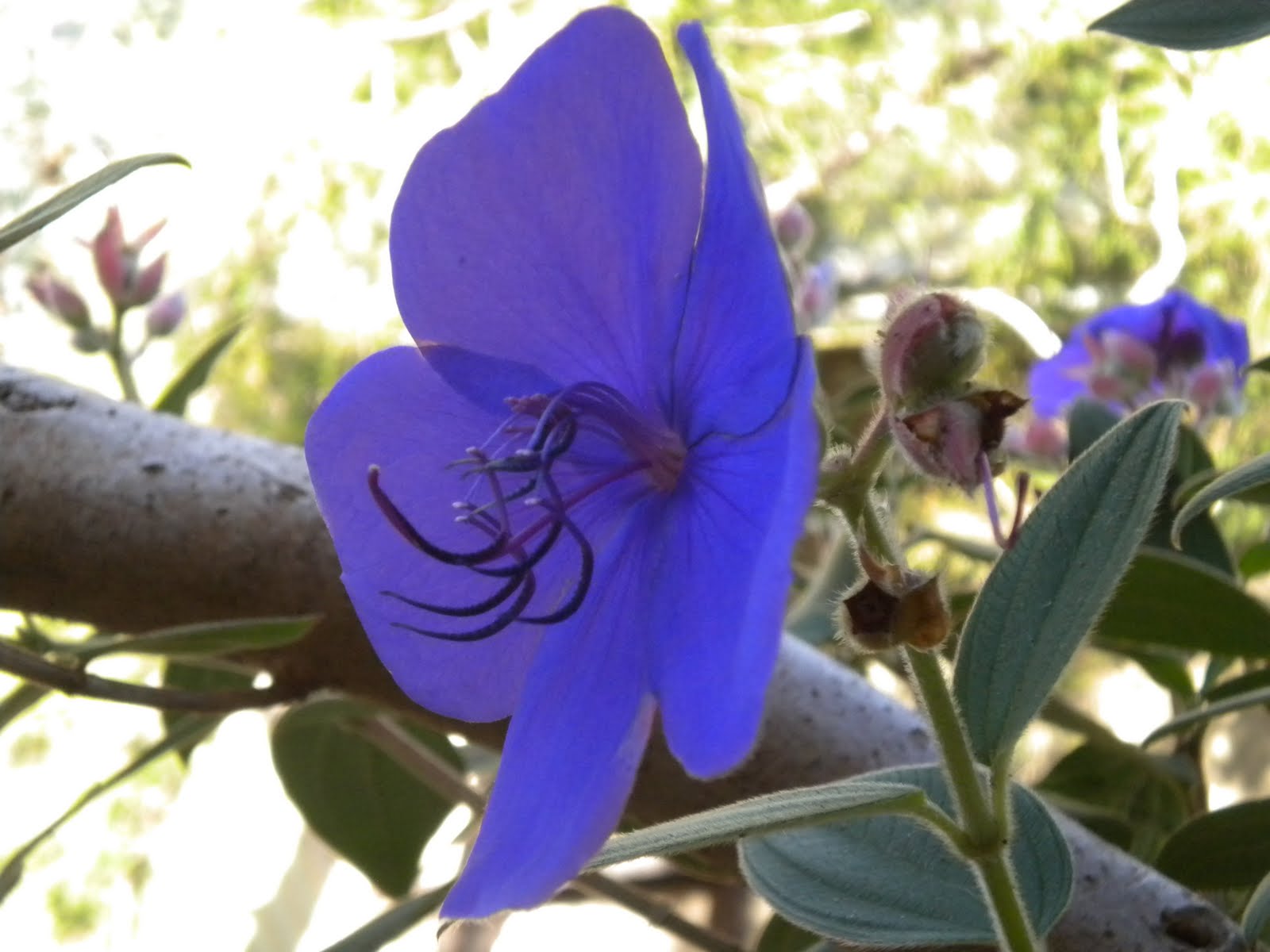
Well, three years later they're still there, hanging on, and instead of trying not to be noticed keep putting on a fabulous show and spreading deep purple petals all over the place, and attracting far too much attention to their purpleness.
No flying under the radar for a Tibouchina. And why would you? Flaunt it, I say.
But for new planting, things can get a little touch and go. After all, the line between blue and purple in the flower world is very fine sometimes. I am occasionally heard to claim: "But it's blue! Honest."
An indigo salvia is, apparently, on the wrong side of the borderline. On the other hand, it turns out bulbs of any kind are also exempt, which is lucky, as I have a weakness for crocuses.

I love a deep purple (iris, say) near bright red (penstemon or salvia, perhaps), or mixed in with a sunshine yellow.
Monty Don claims in The Sensuous Garden that purple "allows other colours to show through more powerfully". Sometimes. On the other hand, in Peaceful Gardens, Stephanie Donaldson recommends a mixture of blue, purple, white and pink to create a relaxing, soothing palette.
I often find the purples in indigenous plants (besides the odd emu bush) to be a rich, deep bluey-purple, or a soft mauve (Westringia), which work beautifully with the blue-grey of the eucalypts in a bush backyard.
The Westringia seems to go unnoticed by the Purple Planting Monitor.
For now.
Sunday, April 25, 2010
On white

I plant a lot of white: plants with white flowers; plants with silver foliage. Why?
- Light coloured foliage can give a sense of depth to your view of a garden
- It is easy on the eye and cooling, especially on hot summer days
- It helps blend flowers and foliage colour that almost, but not quite, go together, such as different reds, crimsons and scarlets; or purple and blue
- It works well as a contrast with dominant colours such as a deep red
- It can spotlight dark corners or shaded spots under trees
- Plants with silver or grey foliage tend to cope well with summer heat and dry conditions
- White works beautifully in the evenings
- In its own right, white is a glorious thing.

(Above: Japanese windflowers - Anemone x hybrida - in a dark spot under a rock bank)
In The Sensuous Garden, Monty Don points out that most white flowers are not actually very close to pure white at all. Anyone who has ever had the misfortune of trying to choose a white paint from a colour card will understand this.
"I'll just paint it white," you think. "Simple." Oh no. No, no, no. There are whole colour cards in your paint shop of different shades of white; some yellow, some verging towards blue or pink; some warm; some cool; some cream, ivory, chalk, almost yellow.

(Above: White valerian mixing with red penstemon and English lavender)
Plants are the same, and of course when it comes to white flowers you are also dealing with something that is, let's face it, almost entirely green with white dots (and even those dots might be dotted with yellow or splashed with red). Convulvulus cneorum, otherwise known as rabbit's dessert around here, is both a lovely soft silver foliage with sharp white flowers, but more often you will find the lovely white flowers set against a deep green - for example on a Cistus ladaniferus (Rock Rose), on which you also get a deep red splodge.
You will have heard and seen photos, no doubt, of Vita Sackville-West's White Garden at Sissinghurst, with its white, cream, silver and grey plants. It wasn't the first single palette garden, but it is certainly one of the most famous, and it spawned a generation of copycats (fair enough, too), though this has made some gardeners wary of using much white.
But don't be afraid. Splash a bit around, like eau de cologne, and enjoy the light.
Friday, April 2, 2010
Worst case scenario planning
Just realised something: after months spent clearing leaf litter and debris in a vain attempt to become fire ready, I had completely gone off gardening. (Don't worry, it's just a phase.)
The bush backyard had become a chore, almost an enemy to be conquered, and as one can never really be fire ready, it seemed we had been defeated.
So I surrendered, somewhere in late January, and have barely lifted a finger since.
That said, summer isn't the best time for gardening in these parts, anyway, because the ground is like concrete and the days are simply too hot to do much. You can't plant anything, all you do is keep things alive. It's a bit like winter is for gardeners in the northern hemisphere, or the wet season in the tropics (although in the tropics, I gather, most of your effort goes into preventing plants from growing too much or where they aren't wanted).
Here there's just lots of watering in the early mornings and the occasional dabble in the veggie patch of an evening, to keep production ticking along.

A tangential realisation is that much of our gardening media, and many books, are all about worst case scenarios. Doesn't matter whether it's about indigenous plants or edible plants or exotics. You get a description of the plant and then a long list of all the terrible things that can go wrong, and another list of all the things you have to do to it over its lifecycle. As if you don't have a life cycle yourself (some of these authors clearly spend more time in their gardens than any normal person, and forget that most of us have a few hours a week, at most, spare for this sort of shenanigans).
An example: lots of articles or books about summer fruit will basically tell you not to bother trying to grow apricots because they are too hard.
Let's just think about that. When I was a kid, lots of suburban houses had an apricot tree in the backyard. The fruit was so plentiful everyone made jars and jars of jam. We had them in our lunch boxes. Sometimes they were a little bug-spotted or small, but still delicious.
Now you buy a handful of apricots for some exorbitant price once or twice a summer, and make jam from the dried fruit because it would be ridiculously expensive to do otherwise.
How did we get here, from there?
Is it really so hard to grow an apricot tree? Clearly, no. Our parents and grandparents didn't have Dynamic Lifter or Pyrethrum or Seasol. They didn't have new hardy varieties and modern rootstocks. At most they had a few cow pats from time to time and some hideous chemical sprays (but only the serious growers used them). Most of them just let nature take her course.
The main issue with apricots boils down to the fact that they blossom early, so the chance of frost at the critical moment is greater than other summer fruits.
So what?
You read on: it says you have to run out every cold night and swathe your tree in horticultural fleece in winter and net it in summer. You have to spray it with this and sprinkle it with that. You have to prune it and coddle it and hold its hand.
You see these pages of instructions and threats and think at the very least: I'd rather buy a bag of apricots for five bucks once a year. It just sounds too hard.
Well, bollocks.
If you love apricots, grow a bloody tree. It's not that hard. Know that once every few years you might not get a crop because of a badly timed frost. You'll cope. Every other year you'll have a tree full of fruit.
It's the same with everything. Sure, you can fuss about and spend your whole life dead-heading and fertilising and applying this or that.
Or you can just help nature along from time to time. Most plants don't want anything more.
If the birds help themselves just a little too much, the next year you can bung a net over the top. If something starts to dramatically affect its chances of survival or production, then, sure, intervene. (That's when you check back with the article or book for a bit of guidance.) Chuck it a handful of poo or slow-release pellets once in a while. Cut off dead growth if there's any.
And let it live its happy little productive life as best it can.
Who could ask for anything more?
PS On the Italian Food Safari last night, my tomato theory was upheld. They like it dry. It's also better for the flavour as it releases the sugar in the fruit. So there's my scientific evidence: Guy Grossi says so.
The bush backyard had become a chore, almost an enemy to be conquered, and as one can never really be fire ready, it seemed we had been defeated.
So I surrendered, somewhere in late January, and have barely lifted a finger since.
That said, summer isn't the best time for gardening in these parts, anyway, because the ground is like concrete and the days are simply too hot to do much. You can't plant anything, all you do is keep things alive. It's a bit like winter is for gardeners in the northern hemisphere, or the wet season in the tropics (although in the tropics, I gather, most of your effort goes into preventing plants from growing too much or where they aren't wanted).
Here there's just lots of watering in the early mornings and the occasional dabble in the veggie patch of an evening, to keep production ticking along.

A tangential realisation is that much of our gardening media, and many books, are all about worst case scenarios. Doesn't matter whether it's about indigenous plants or edible plants or exotics. You get a description of the plant and then a long list of all the terrible things that can go wrong, and another list of all the things you have to do to it over its lifecycle. As if you don't have a life cycle yourself (some of these authors clearly spend more time in their gardens than any normal person, and forget that most of us have a few hours a week, at most, spare for this sort of shenanigans).
An example: lots of articles or books about summer fruit will basically tell you not to bother trying to grow apricots because they are too hard.
Let's just think about that. When I was a kid, lots of suburban houses had an apricot tree in the backyard. The fruit was so plentiful everyone made jars and jars of jam. We had them in our lunch boxes. Sometimes they were a little bug-spotted or small, but still delicious.
Now you buy a handful of apricots for some exorbitant price once or twice a summer, and make jam from the dried fruit because it would be ridiculously expensive to do otherwise.
How did we get here, from there?
Is it really so hard to grow an apricot tree? Clearly, no. Our parents and grandparents didn't have Dynamic Lifter or Pyrethrum or Seasol. They didn't have new hardy varieties and modern rootstocks. At most they had a few cow pats from time to time and some hideous chemical sprays (but only the serious growers used them). Most of them just let nature take her course.
The main issue with apricots boils down to the fact that they blossom early, so the chance of frost at the critical moment is greater than other summer fruits.
So what?
You read on: it says you have to run out every cold night and swathe your tree in horticultural fleece in winter and net it in summer. You have to spray it with this and sprinkle it with that. You have to prune it and coddle it and hold its hand.
You see these pages of instructions and threats and think at the very least: I'd rather buy a bag of apricots for five bucks once a year. It just sounds too hard.
Well, bollocks.
If you love apricots, grow a bloody tree. It's not that hard. Know that once every few years you might not get a crop because of a badly timed frost. You'll cope. Every other year you'll have a tree full of fruit.
It's the same with everything. Sure, you can fuss about and spend your whole life dead-heading and fertilising and applying this or that.
Or you can just help nature along from time to time. Most plants don't want anything more.
If the birds help themselves just a little too much, the next year you can bung a net over the top. If something starts to dramatically affect its chances of survival or production, then, sure, intervene. (That's when you check back with the article or book for a bit of guidance.) Chuck it a handful of poo or slow-release pellets once in a while. Cut off dead growth if there's any.
And let it live its happy little productive life as best it can.
Who could ask for anything more?
PS On the Italian Food Safari last night, my tomato theory was upheld. They like it dry. It's also better for the flavour as it releases the sugar in the fruit. So there's my scientific evidence: Guy Grossi says so.
Thursday, April 1, 2010
I have issues
I have tomato issues.
I also have tomato theories. They run like this: tomatoes are a bit like fine wine grapes. They like a bit of rough treatment. No molly-coddling.
Tomatoes need regular water and the occasional feed but what they want most is sun.
I don't hold with the school of thought that pours water onto tomato vines. Even less with the greenhouse-bred sort. I know I'm not alone in this.
I reckon tomatoes like it dry. It toughens up the plants and gives body and flavour to the fruit.
Many of the diseases and pests to which tomatoes fall prey can be triggered by too much water, or indeed too much fertiliser, which leads to a great many leaves and plants like Jack's beanstalk, but fewer fruiting flowers.
And anyway, I'm too lazy and there isn't enough water to keep them moist.
So then we get these sudden downpours. Not just one, but several. It's a shock to humans, since we aren't used to seeing that much water falling from the sky at once anymore, but it's more of a shock to the tomatoes.
Going from dry to sodden can have all sorts of effects:
Too much rain is worse than not enough. The water somehow makes the tomatoes watery. I have no scientific evidence for this whatsoever, besides my tastebuds. But there you go.
While we can't do much about the downpours, besides harvest as much of the water as possible for later use, we can:
By the way, at 7.30 on SBS's Italian Food Safari tonight (1/4), Maeve O'Meara gets stuck into tomato day with an Italian family and it's all about tomatoes. As it should be.
I also have tomato theories. They run like this: tomatoes are a bit like fine wine grapes. They like a bit of rough treatment. No molly-coddling.
Tomatoes need regular water and the occasional feed but what they want most is sun.
I don't hold with the school of thought that pours water onto tomato vines. Even less with the greenhouse-bred sort. I know I'm not alone in this.
I reckon tomatoes like it dry. It toughens up the plants and gives body and flavour to the fruit.
Many of the diseases and pests to which tomatoes fall prey can be triggered by too much water, or indeed too much fertiliser, which leads to a great many leaves and plants like Jack's beanstalk, but fewer fruiting flowers.
And anyway, I'm too lazy and there isn't enough water to keep them moist.
So then we get these sudden downpours. Not just one, but several. It's a shock to humans, since we aren't used to seeing that much water falling from the sky at once anymore, but it's more of a shock to the tomatoes.
Going from dry to sodden can have all sorts of effects:
- Skin splits
- Fruit taste diminishes
- Split fruits attract fruit fly and all sorts of nasty things
- Mouldy fruit
- Fungal infections.
Too much rain is worse than not enough. The water somehow makes the tomatoes watery. I have no scientific evidence for this whatsoever, besides my tastebuds. But there you go.
While we can't do much about the downpours, besides harvest as much of the water as possible for later use, we can:
- Remove fruit with split skins or any kind of damage and give them to the chooks
- Harvest any ripening fruit and let them redden on a kitchen windowsill inside, especially if you expect a storm
- Spray with garlic & pyrethrum if fruit fly or other nasties are about
- Remove any dead or dying branches, and also any leaves or shoots tangled up in the centre of the plant, to let air circulate
- Use a fungicide if you must but harvest a good supply first
- Re-tie the stems so none are sagging.
By the way, at 7.30 on SBS's Italian Food Safari tonight (1/4), Maeve O'Meara gets stuck into tomato day with an Italian family and it's all about tomatoes. As it should be.
Subscribe to:
Posts (Atom)